De la Espriella failed to make Colombia secure in 90 days – Colombia News
- Colombia
- noviembre 11, 2026
- No Comment
- 7
Colombia’s far-right President Abelardo de la Espriella failed to live up to his promise to “recuperate” state-control of conflict regions through a “shockwave” of hardline security measures within 90 days in office.
His first three months in office ended this week, and by almost every metric violence is rising.
Non-state armed groups and organized criminal groups alike have staged a series of attacks on security forces and their infrastructure, likely in retaliation for aggressive security actions that have included bombings carried out by Colombian aerial forces (which have killed at least 8 minors).
It would seem the shockwave is being carried out by not-state, rather than state forces.
According to new data published by the country’s Ombudsman’s Office and police, extortion, homicides, acts of “terrorism”, kidnappings, and attacks on security forces have all risen since De la Espriella assumed the presidency. Thirty-eight members of the police or military have been killed, and 213 wounded in attacks by criminal groups.
Child-recruitment by non-state armed groups has also risen dramatically: 131% higher than former President Gustavo Petro’s first 90 days in office.
Although De la Espriella has made concrete changes from the policy of his predecessor — destruction of coca is up, and the right-wing president has dismantled previously ongoing negotiations and peace processes with some criminal groups — much of his administration’s security policy has been more about optics than substance.
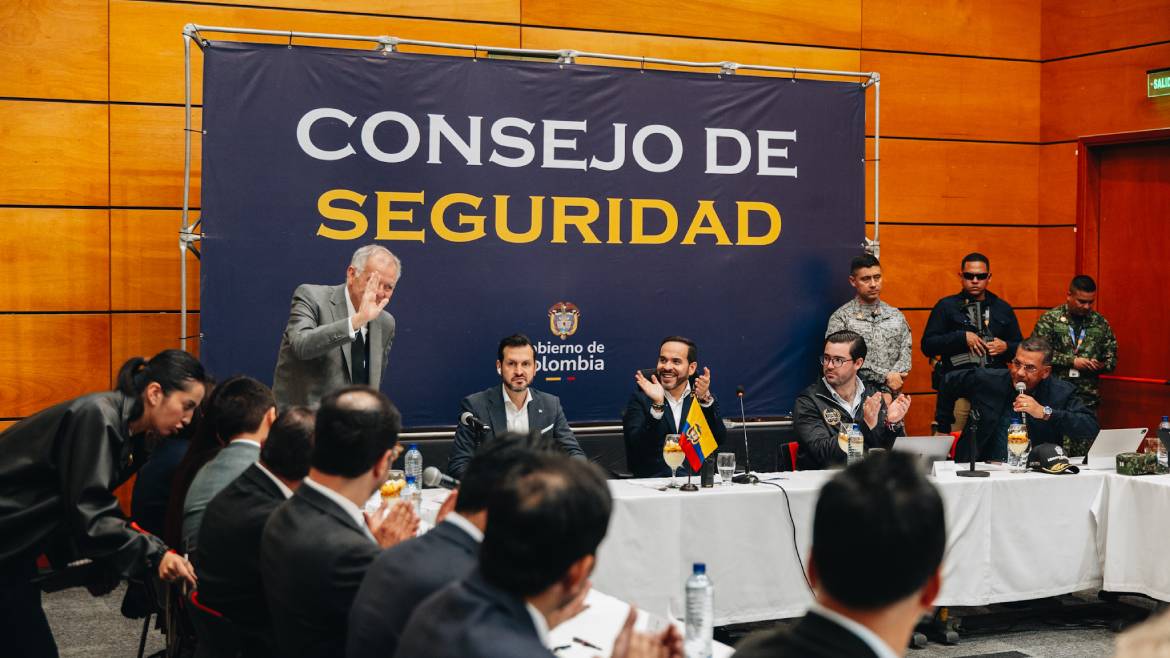
The president has released videos of himself walking among the bodies killed by aerial bombings, and has taken to showing up in affected cities wearing a pistol on his hip, and carrying a walkie-talkie.
During an operation in Cucuta, in the province of Norte de Santander, on November 10, De la Espriella spoke with military officials armed, wearing a military uniform and a red military-style beret.
The same day, The National Liberation Army, ELN, the largest remaining rebel group in the country, carried out a drone attack on a military base in the north of the same department that killed at least one soldier and wounded 4 others.
His Ministry of Defense released a video of him interrogating and mocking a member of FARC-dissident group the 33rd Front, telling him “welcome to Patria Milagro,” the miracle country —a slogan from his campaign during elections.
In September, paramilitary group the ACSN shut down large parts of the northern coast, including the city of Santa Marta. In a show of power, the ACSN even defied a response-deployment by Colombian military forces to the region to continue the forceful shutdown as the military largely stood by powerless.
De la Espriella has since militarized both Santa Marta and Cucuta, a measure which seems to have had little effect on the day-to-day operations of non-state armed groups in the regions.
De la Espriella has also repeatedly requested help from the US, and invited them to participate in his security crackdowns. In September, the President met with US Secretary of State Marco Rubio to sign a series of agreements he calls the “Barranquilla Accords.” Colombia agreed to give US companies preferential treatment regarding mining contracts, particularly involving rare earth minerals, in return for US security assistance and drone technology, among other things.
De la Espriella has attempted to align Colombian and US interests in security in the region, and talked repeatedly of extraditing “high priority targets,” to the US rather than charge them under Colombian law.
At a press conference with Rubio, De la Espriella announced what he called a “21st-Century Plan Patriot.”
Named after an aggressive security operation by former right-wing President Alvaro Uribe, the president said the agreement with the US will “modernize aircraft, radars, drones, helicopters, anti-drone systems, air defense, mobility, intelligence, cyber defense, special forces, and maintenance and operations.”
Armed groups currently operate in 24 of Colombia’s 32 provinces — roughly 75% of the country. That was true before De la Espriella took office, and the president’s promise to change that within three months has so far yielded little to change that.